
The 1st International Conference on Research and Innovations in Information and Engineering Technology 2025
Ended
Swiss-Belhotel Makassar
Makassar City, South Sulawesi, Indonesia
(Hybrid Conference) -
See on Maps
6-7 September 2025

"Sustainable Solutions: Leveraging Information and Engineering Technology"
The 1st International Conference on Research and Innovation in Information and Engineering Technology 2025 (RITECH 2025) is a hybrid international conference focusing on “Sustainable Solutions: Leveraging Information and Engineering Technology.” Hosted by the Department of Informatics, Hasanuddin University, RITECH 2025 will bring together researchers, developers, and professionals from both academia and industry to present the latest scientific and theoretical advances, discuss, and showcase state-of-the-art developments in Information Technology (IT) and Engineering. The conference aims to explore the innovative applications of information and engineering technologies to address global sustainability challenges.
All accepted full-text papers that are registered and presented at the conference will be published in the conference proceedings. Furthermore, selected papers will be submitted to the conference series proceedings in major indexing databases, including SCOPUS, WoS, etc.
kEYNOTE Speakers

Prof. Patrick Olivier, PhD
Professor, Department of Human Centred Computing, Monash University
Research Interest: Co-design Methods, Digital-in-Health, Technology-Enhanced Learning, Collaborative Computing, Social Computing, Media Computing.

Assoc. Prof. Dr. Sudip Roy
Associate Professor, Departement of Computer Science and Engineering, Indian Institute of Technology Roorkee
Research Interest: Electronic Design Automation and Embedded System Design, Algorithm Design and Optimization Techniques, Microfluidic Biochips, CAD for VLSI, Cyber-Physical and IoT-based System Design, ICT for Disaster Management, Applications of Machine Learning

Assoc. Prof. Dr. Chong Yung Wei
Associate Professor, School of Computer Science, University Sains Malaya
Research Interest: Cyber physical system, cloud computing, artificial intelligence, cyber security

Prof. Dr. Muhammad Suryanegara, ST, M.Sc, IPU
Professor, Electrical Engineering Department, Indonesia University
Research Interest: Telecommunication, Mobile Wireless Technological Innovation and Policy
Registration Fee
Professional
Student
Early Bird
Attendee Non Presenter
| Category | Overseas Participant | Local Participant |
|---|---|---|
| Professional | $350 | IDR 3.500.000 |
| Student | $325 | IDR 3.250.000 |
| Early Bird | $300 | IDR 3.000.000 |
| Attendee Non Presenter | $75 | IDR 750.000 |
Important dates

NO-SHOW POLICY
Please take note that RITECH has a strict policy on No-Show. Accordingly, if a paper is accepted, at least one of the authors or an authorized representative must deliver the presentation, either in person at the conference, online, or through the submission of a complete recorded presentation.
Papers for which no presentation is made shall not be submitted for inclusion in the RITECH proceedings. In such cases, the registration fees paid by the author(s) shall be non-refundable.
Exceptions to this policy will be made in rare and unusual situations by the RITECH Organizing Committee only if there is evidence that the no-show occurred because of unanticipated events beyond the control of the authors, and that every option available to the authors to present the paper was exhausted.
PAPER REVIEW PROCESS
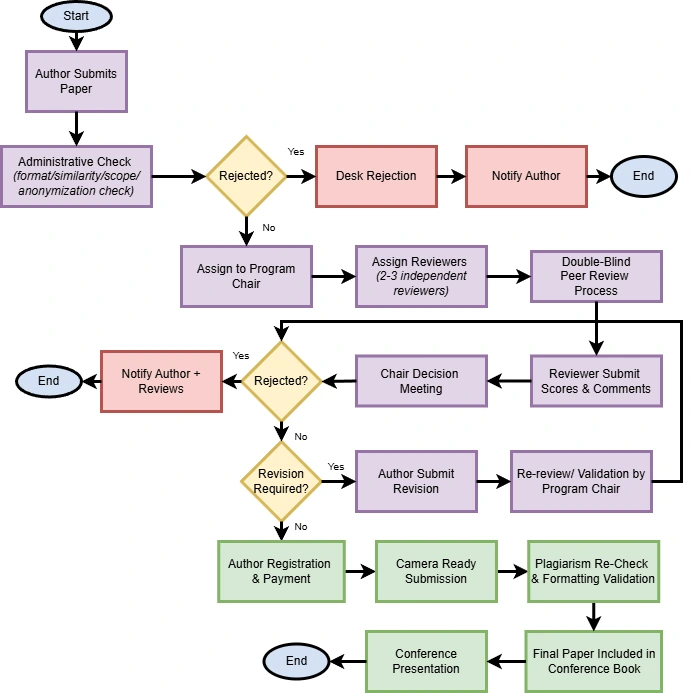
The rigorous double-blind peer review process begins with manuscript submission through an online system, followed by an initial editorial screening to ensure relevance, quality, and ethical compliance. Suitable manuscripts are assigned to two or three expert reviewers under a double-blind system to ensure objectivity by carefully considering potential Conflicts of Interest (CoI) and balancing reviewer workload. Reviewers assess originality, methodological soundness, clarity, and contribution, providing detailed feedback and recommendations. Based on these evaluations, the program chair convenes a decision meeting to determine whether the manuscript will be accepted, subjected to minor or major revision, or rejected. Selected manuscripts may subsequently be issued a Letter of Acceptance (LoA) for presentation. Authors must address reviewers’ comments in a structured response, and revised manuscripts undergo re-evaluation before final acceptance. Only papers that successfully complete all review and validation stages are included in the conference proceedings and presentation session, ensuring that only high-quality, rigorously reviewed research is published.
RESEARCH & INNOVATION SCOPE
The topics of interest for submission include, but are not limited to:
- Artificial Intelligence, Machine Learning and Deep Learning
- Reinforcement Learning
- Bioinformatics
- Computer Vision and Pattern Recognition
- Expert System
- Signal Processing
- Computational Intelligence
- Natural Language Processing
- Speech Recognition
- Audio processing
- Semantics Sentiment Analysis
- Machine Translation and Summarization
- Data Collection & preprocessing
- Statistical Analysis
- Predictive Analytics
- Data Visualization
- Industrial IoT
- Advanced Sensor and Calibration
- Cloud and Virtualization
- Embedded device
- Network Optimization
- Sensors and Robotics Intelligence
- Smart Home and Smart City
- Smart Environment and Tangible Interaction
- Wearable Devices
- Data Compression
- Distributed Systems and Parallel Processing
- Anonymity and Privacy
- Data Communication
- Digital forensics
- Hardware and Physical Security
- Security Management and Policies
- Blockchain Technology
- Wireless Communication
- Cyber-Physical System
- Computer Network
- Robotics and Autonomous Systems
- Visual and Multimedia Computing
- Augmented Reality
- Virtual Reality
- Computer game methodology, design, and development
- Computer Graphics
- Computer Animation
- Digital Image Processing
- Human-Computer Interaction
- Mixed Reality
- Multimedia tools and application
- Computer Game Development
- User Interface and User Experience
- Computational Mathematics and Modeling
- Optimization Methods & Algorithm
- Simulation and Stochastic Processes
- Statistical Computing
- Software Engineering
- Internet and Web Engineering
- Mobile Computing
- User Modeling and Management
- Design Patterns and Frameworks
- Engineering of Embedded and Real-time Software
- Theory, Formal Methods and Tools
- Object-Oriented Technology
- Reengineering, Reverse Engineering
- Software Dependability
- Software Economics and Metrics
- Ubiquitous and Pervasive System
- Software Policy and Ethics
- Software Testing and Analysis
- Computer Based Education
- Database Systems
- E-commerce and E-governance
- Information Engineering
- Data Mining and Knowledge Recovery
- Semantics Web and Linked Data
- Decision Support System
- Social Media Analytic
- Distributed file systems
- Big data technologies
- Data capture and storage
- Geographic information system (GIS)
- Remote Sensing
Committee
- Indrabayu, Universitas Hasanuddin, Indonesia
- Andani Achmad, Universitas Hasanuddin, Indonesia
- Ansar Suyuti, Universitas Hasanuddin, Indonesia
- Novy N.R.A. Mokobombang, Universitas Hasanuddin, Indonesia
- Arliyanti Nurdin, Universitas Hasanuddin, Indonesia
- Herlina Anwar, Universitas Hasanuddin, Indonesia
- Muhammad Alief Fahdal Imran Oemar, Universitas Hasanuddin, Indonesia
- Christoforus Yohannes, Universitas Hasanuddin, Indonesia
- Tyanita Puti Marindah Wardhani, Universitas Hasanuddin, Indonesia
- Intan Sari Areni, Universitas Hasanuddin, Indonesia
- Misita Anwar, Swinburne University of Technology, Australia
- Mukarramah Yusuf, Universitas Hasanuddin, Indonesia
- Anugrayani Bustamin, Universitas Hasanuddin, Indonesia
- Eka Qadri Nuranti B, Institut Teknologi Bacharuddin Jusuf Habibie, Indonesia
- Zaenal Abidin, Teknokrat Indonesia University, Indonesia
- Yunifa Miftachul Arif, Maulana Malik Ibrahim State Islamic University Malang, Indonesia
- Jairo Gutierrez, Auckland University of Technology, New Zealand
- Herlina Binti Abdul Rahim, Universiti Teknologi Malaysia (UTM), Malaysia
- Amil Ahmad Ilham, Universitas Hasanuddin, Indonesia
- Adnan, Universitas Hasanuddin, Indonesia
- Izza Anshory, Universitas Muhammadiyah Sidoarjo, Indonesia
- Anton Satria Prabuwono, Universiti Teknologi Petronas, Malaysia
- Faizal Arya Samman, Universitas Hasanuddin, Indonesia
- Ingrid Nurtanio, Universitas Hasanuddin, Indonesia
- Shankar Karuppayah, Universiti Sains Malaysia (USM), Malaysia
- Fares Ahmad Muhammad Ghaleb, King Abdulaziz University, Saudi Arabia
- Dewi Rahmawati, Telkom University, Indonesia
- Kunti Robiatul Mahmudah, Ahmad Dahlan University, Indonesia
- Syafruddin Syarif, Universitas Hasanuddin, Indonesia
- Rizal Setya Perdana, Brawijaya University, Indonesia
- Muhammad Niswar, Universitas Hasanuddin, Indonesia
- Zulkifli Tahir, Universitas Hasanuddin, Indonesia
- Maulisa Oktiana, Syiah Kuala University, Indonesia
- Fariska Zakhralativa Ruskanda, Bandung Institute of Technology, Indonesia
- Ady Wahyudi Paundu, Universitas Hasanuddin, Indonesia
- A. Ais Prayogi Alimuddin, Universitas Hasanuddin, Indonesia
- Elly Warni, Universitas Hasanuddin, Indonesia
- Abdul Azis Lihawa, Moslem University of Indonesia, Indonesia
- Muhammad Abdillah Rahmat, Universitas Hasanuddin, Indonesia
- Syafaruddin, Universitas Hasanuddin, Indonesia
- Ardiaty Arief, Universitas Hasanuddin, Indonesia
- Zaenab Muslimin, Universitas Hasanuddin, Indonesia
- Dadang Gunawan, University of Indonesia, Indonesia
- Muh. Anshar, Universitas Hasanuddin, Indonesia
- Naser Jawas, Institute of Technology and Business (ITB) STIKOM Bali, Indonesia
- Yusri Syam Akil, Universitas Hasanuddin, Indonesia
- M Bachtiar Nappu, Universitas Hasanuddin, Indonesia
- Zahir Zainuddin, Universitas Hasanuddin, Indonesia
- Rismayani, DIPA Makassar University, Indonesia
- Amri, Lhokseumawe State Polytechnic, Indonesia
- Dewiani, Universitas Hasanuddin, Indonesia
- Mohamad Yani, Telkom University, Indonesia
- Fitria, Banjarmasin State Polytechnic, Indonesia
- Imene Zenbout, University Ferhat Abbas of Setif, Algeria
- Kurnia Prima Putra, State University of Makassar, Indonesia
- Dessy Santi, Tadulako University, Indonesia
- Prof. Dr. Kailash Chandra Bandhu, Medicaps University, India
- Akshay Aggarwal, IEEE, USA
- Raghavender Reddy Puchhakayala, University of Missouri Kansas City, USA
- Bhaskar Bharat Sawant, Cornerstone Building Brands, USA
- Kuber Jain Rajendra Jain, Headspace), USA
- Nishanth Sirikonda, Generac), USA
- Gia Septiana Wulandari, Telkom University, Indonesia
- Muhammad Arief Nugroho, Telkom University, Indonesia
- Akhmad Irsyad, Mulawarman University, Indonesia
- Andi Prademon Yunus, Telkom University, Indonesia
PROCEEDING

Supported By


Publication
Proceedings will be submitted for evaluation for indexing by SCOPUS, Ei Compendex, Semantic Scholar, Google Scholar, and Microsoft Academic.


Patrons


Connect With Us
Department of Informatics, Faculty of Engineering, Hasanuddin University. Jl. Poros Malino Km.6, Gowa, South Sulawesi, Indonesia.